It is finally ready! My rules for alternate dungeon crawling or exploration for Cairn 2nd edition.
Like I alluded in my review of Desert Tomb Raiders I used the Deck of Dungeons by Tales from the Stinky Dragon to create random dungeon crawls. But these rules were done for Dungeons & Dragons 5th Edition, so I adapted them (with some changes) to Cairn 2nd Edition. I finally was able to formalize my notes into a coherent rules document for you to use.
This article shows the process and changes I did to the original rules and my thought processes behind it.
Inspiration
Let's start with the original rules for those that are not aware.
A dungeon, which can be for a example a labyrinth or maze, is represented as a deck of cards. Every round the top three cards are presented to the players face down. It is an abstraction of the paths the characters can take in this dungeon. The active player can then do an action, which manipulates these three cards or the deck, and then flips over one of the face down cards.
Depending on the card flipped, different effects will happen. The goal is to flip over 5 "Clear Path" cards. This then means, the characters have found their way through this dungeon. Along the way they might have encounters or face obstacles, which essentially block a choice from the three cards.
This system is great, since it lets the player have an active role within the dungeon. They can use their environment as an adventurer naturally would. There's choices to be had and since you go around the table with the player that flips a card, everybody does something. Dungeon crawling does not degenerate into one player just going ahead and repeat the same actions over and over.
Balls, balls, balls
However there are some points I wanted to change in my implementation after some testing. Instead of having a deck of cards, I choose a bag full of balls.
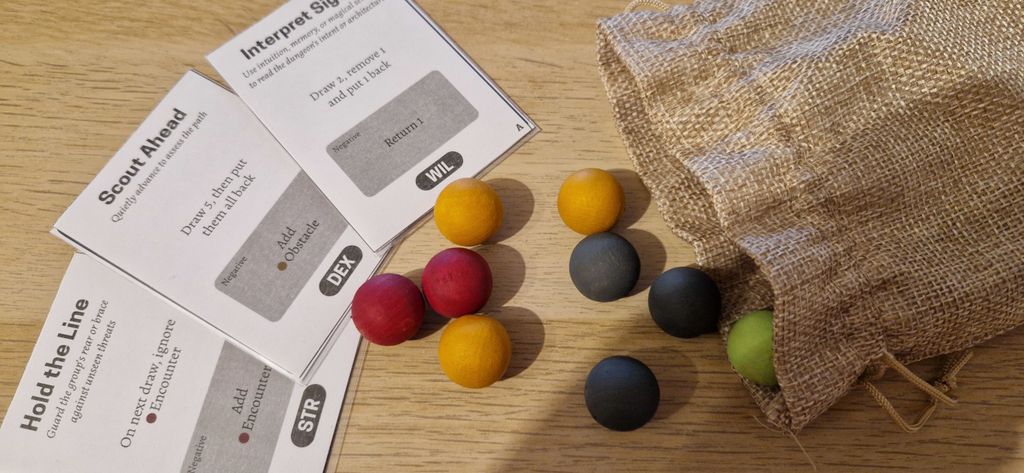
The reasoning behind this is, that it is much easier to shuffle and manipulate the contents of this bag than it is a deck of cards. The deck normally contains of something like 15-20 cards which is somewhat awkward to shuffle efficiently. A bag I can just shake.
The other thing that happen to me is, that I quickly forgot which pile was the discard pile and which one was the actual draw pile. This is, because in the original rule, you should always discard all cards face down, face down. So you end up with two face down piles. A problem I will never have with a bag. It is completely opaque so the players will never know its content. I don't have to differentiate.
Consequences
Cairn has a different philosophy when it comes to actions and dice rolls. Dungeons & Dragons is much more frequent and might not necessarily have an impact. You would roll to see if you succeed in doing an action. If you don't, you just don't get to do an action.
In Cairn however, when you roll it is because there's a possibility of consequence. That is why it is called a save. There's a risk. Otherwise you wouldn't roll.
I'm a fan of delayed consequences as you should know by now. And my system allows for a very elegant version for that. When you fail you just add balls into the bag. The dungeon is fighting back in some way or another. That's the risk you take. It might not affect you at all, or it might be the consequences of your actions.
And it is quick to implement for the GM. Just throw a ball into the bag. Shake. Done.
It creates very tense and memorable moments. I had a game, where the players needed one Progress to complete the dungeon, but they also had three encounter balls left in the bag. From a previous action, they knew these odds. In their mind it played out, like they were chased by some horrible monsters in this dungeon. Their only chance was to flee as quickly from this place. They drew: Progress. They cheered. We had fun. Epic.
Actions
Which brings me to the point of the actions. I had the feeling that the original actions didn't have too much impact in the overall structure.
Let's take the Optimize Options action. Essentially you exchange one card of the three face down cards with a new one. But you don't know where it is. You might have some more information sure, that one option is good. Still you just take a guess as if three unknown cards would lie before you. It's a false sense of choice. A quantum ogre.
My actions mostly manipulate the odds and give you a little information. I don't give you the illusion of choice. I give hope or dread.
There are two different actions per attribute. And each attribute has a designated consequence, that should give a flavourful consequence when you failed that save.
To avoid, that some actions are taken more often than others, I implemented a simple system where the action that you can do, changes. This can be achieved by simply having the actions for each attribute on a single card that you flip over.
Toolbox
I now keep this bag with the three cards in my GM bag. Whenever I need to create a random dungeon on the spot, I can just grab it and play. It is a wonderful and easy to implement tool in my arsenal. It takes very little prep and gives the players so much depth.
Try it out. Give Feedback.