What makes monsters interesting? A recent article from Sly Flourish got me thinking about monsters a bit more. Especially how monsters can be interesting for the players and not be too complicated for the GM to run.
The article in question is called Make Monsters Unique. In it, Mike Shea writes, that with description we can make monsters unique. So instead of just labelling the monster as an ogre, we can describe a towering mass of muscles with a tree trunk in its hand.
What is interesting about this is, that the players come to the conclusion, that this monster will hit very hard, so it is important to avoid getting on the wrong end of that tree. And in my opinion this is the core of what makes monsters (and in extension combat) more interesting: Players and characters having to adapt their strategy, because of things they see (or experience).
Beyond the Stat-Block
At the beginning of every monster is the stat-block. Some numbers and words that describe it in its physicality. I've discussed in the past how it could be improved, especially in pre-written adventures.
As a GM this is what stops me in my tracks the most often when either preparing a session or actually running a combat. I have to scramble for that stat-block again. How much was the AC again? How many life points? Oh, you want to grapple it. Let me check the strength score of it.
In actuality, the exact numbers do not really make a difference here. Often the stats only differ in like 1 or 2 points for monsters on the same levels. Or the values are switched around (Strength instead of Intelligence as its highest stat). Higher level monsters just have more of it in the same stat.
Look for example at stat-blocks for some of the dragons in D&D.
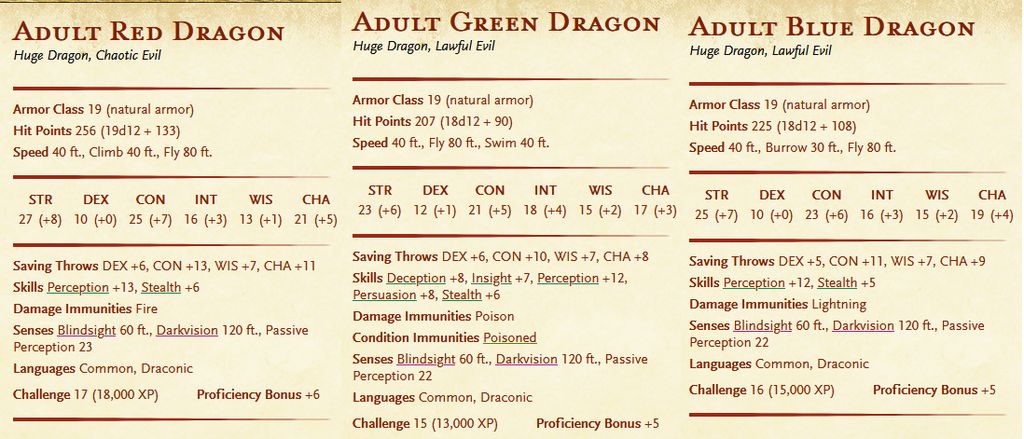
Just some slightly different numbers, but in essence they are just the same. I know why they probably did it that way, so that they have a different CR value. But CR never worked anyway and who actually cares? Well, Hasbro because they can sell a thicker book I guess.
A conclusion that others have also come to, and proposed to Just use bears. You could concentrate it down to a "handful" of stat-blocks and that's it. One Dragon stat-block is more than enough.
Look Mom, No Hands
What is then actually different about these dragons? Their breath weapon. And what does it do? Well you can guess or infer it from their colour. And here we are back at what I said at the beginning: Let the players figure things out and then adapt their strategy around it. It also gives you a hint on how you could describe the monster. The air is crackling with energy as the dragon steps into view, opening its mouth.
So what you need is special abilities or behaviour. That's what makes them interesting in the first place. The stat-block is just extra. Who cares if the goblin has 6 or 7 health. If they sneak around and use dirty tricks to gain the upper hand, they stay much more in players memory, than just a mere stat-block.
So when adapting or creating a monster, all you have to do is to take one of the universal stat-blocks like a bear and put some interesting abilities on it.
That's what videogames do. Simplified, there are three variables for an enemy: Speed, Resilience and Damage. Pick two of them to be great and one to be bad. So for example a quick and high damage enemy, should not have a lot of health (or armour). The typical glass cannon. Similarly a high damage enemy with a lot of health, should be slow (ogre anyone?).
So you see, videogame enemies also just have a pool of simple stat-blocks. As a seasoned player you can already guess which is the bad variable. But what makes it interesting is how the enemy behaves. That what makes cool and memorable enemy design in games. The enemy knows about their weakness and could for example hide in a force-field that you first need to deactivate before you can hit them.
And we can use these same principles for designing and using monsters as well. It also makes it easier for me as a GM to run and more fun, because I get to roleplay more instead of focusing solely on the mechanics of a stat-block. I can taunt the players from behind the force-field.